

The Competitive World of Cross Country Running
Cross country running is one of the most demanding sports that athletics has to offer, combining a tough test of physical and mental endurance across a changing terrain. Each race presents a different challenge. Throughout this blog, you’ll find out what makes cross country so difficult, how demanding it truly is, and what a proper uniform can do for your team.
What Makes Cross Country So Competitive?
Course Variability and Conditions
Cross country running is already one of the most competitive sports based on the team dynamics alone, but the course conditions play an even bigger role in the scheme of things. When running in cross country, you aren’t running laps around a track. In fact, you are typically running through rough terrain with lots of obstacles, hills, and wooded areas. This can actually be harmful to the runners; awkward footing forces runners to constantly adjust their stride, balance, and pacing during competition.
With outdoor terrains, the weather plays a significant role during races. The heat, rain, humidity, wind, etc. can all factor into a runner's performance. Running in extreme heat can lead to early fatigue and dehydration, while cold or wet conditions can stiffen muscles and increase discomfort while running, even leading to injury. Muddy courses can slow runners down significantly, turning races into tests of pure strength and determination. Athletes must be prepared to adapt not just their race strategy, but also what they wear and how they manage their endurance.
Race Strategy and Pacing
Even though runners compete individually, their placement amongst their team is what’s scored, which classifies this as a team sport. The top five finishers per team contribute to the overall score. This forces runners to be aware of themselves and their teammates while running, so teams devise certain strategies to improve their placement/times. Strategies such as pack running, where every member stays close to each other to push the pace of the race. This works especially well in cross country running because success comes from having a well-coordinated group, not the fastest person.
As much as the weather plays a factor in cross country running, the mental aspect can also wear down runners, making the race that much more difficult. Races last a long time, and fatigue is inevitable, so runners need to have a strong mentality when starting a race because they can’t give up halfway through it when things start to get tough. Not to mention the lack of feedback they have out there. There is no scoreboard telling each athlete their place and time; they just have to stick to their plan and trust that the pace they ran was good enough. Their pace is the name of the game and is what decides an athlete's success. Knowing how to distribute their energy is something each cross country runner needs to have a grasp on in order to control their pace. The hills, terrain, weather, and mentality are all things a runner needs to conquer during a race, and having a good strategy to preserve energy and use it when needed is how they come out victorious.

This runner’s uniform features a zigzag pattern and color layering that makes the logo really stand out.
Training and Performance Demands
Endurance vs Speed Balance
While cross country may seem like it depends on speed, it really depends on endurance. Sure, it’s a timed event, so being the fastest time means you win, but in reality, it’s not about who can run the fastest. It’s about who can run the longest at a controlled, winning pace. Runners will log miles upon miles each week to try to build their aerobic endurance in order to run a steady pace throughout the event. This consistent training also develops stamina, allowing athletes to sustain their effort over long distances and push through fatigue in the later stages of a race. As mentioned above, speed isn’t the name of the game, but that doesn’t mean that it doesn’t matter. It’s all about a healthy blend of both. Speed is critical in certain moments, such as race starts, hill surges, and final sprints to the line. The best runners are those who can combine their stamina with the ability to accelerate when they need it most. Speed and endurance go hand in hand, and both need to be worked out in order to be in the greatest position to succeed.
Cross Country Training
Since cross country is so demanding, athletes need to constantly maintain their bodies. Strength training is very prevalent in cross country, even though it isn’t a physical sport. Runners undergo core workouts, leg strength exercises, and mobility routines to try to perfect their running form. Having strong muscles is a way to balance efficiency through the late stages of a race when fatigue begins setting in. The runners with well-developed muscles have a better ability to maintain their form while experiencing great fatigue, which prevents wasted energy during the race. This efficiency can make the difference between holding pace and falling behind the pack.
Training is just one side of the equation, though, because recovery is just as important for body maintenance. The body is under constant stress during cross country training and races, so a lack of proper recovery could leave the athlete at a greater risk for injury. Shin splints, stress fractures, and tendon issues are all very prevalent in this sport and can linger with a person for long periods of time, so properly recovering is the best thing each athlete can do for themselves. Recovery starts with rest and simply getting off your feet. A schedule is a great way to plan out the workout and rest days to optimize growth. From there, each runner should be doing some kind of mobility/flexibility training. The use of foam rollers to smooth out each muscle knot can be very beneficial since it also promotes blood flow with little to no added strain. Stretching routines and dynamic warmups are great ways to reduce muscle tightness and increase the range of motion in each runner, leading to smooth, efficient movements that are needed for each race.
Cross Country Uniforms and Performance
Why Uniform Design Matters in Competition
Uniforms shouldn't hold athletes back during any sport, and luckily, cross country has the same standard. In fact, uniforms are built to be lightweight and breathable for long distance running. Thanks to their lightweight fabrics, the reduced weight allows for more energy to be stored for crucial moments during the race. They also have moisture-wicking technology to keep runners dry from sweat. Poorly designed uniforms don’t feature any of this and can lead to distractions during the race like overheating or restricted movements. It’s important to get quality uniforms for runners to ensure they are comfortable and able to compete.
Fit and Functionality
The fit of the uniform can actually impact a runner's performance. There are two main fits that runners choose from, the first being the loose fit. This choice offers a larger jersey or a jersey made with different materials so that it can sit comfortably away from the body. There is also the tight fit, which is made of materials that give more of a compression effect. It hugs the body closer than the loose fit and can reduce drag while running. It’s the style that many runners prefer nowadays, but there are uniform options for various types of athletes to create a nice balance between comfort, mobility, and performance.

This features a runner competing in the MHSAA regional tournament, trying to earn a place in the state championship.
Cross Country Jersey Design Trends
Popular Design Styles
Some of the most popular jersey designs in the sport offer bold colors, a gradient pattern, or a simplistic look, but each one is unique to a different team. Some teams prefer a minimalist style, which focuses on clean lines and color schemes that don’t draw much attention to them. The teams that utilize this look are often trying to highlight professionalism within their team. They are there to compete and focus entirely on their performance. Other teams prefer a bolder look to stand out from the group. They achieve this by using bright colors or high contrast color combos, which are extremely useful to identify teammates quickly while running so athletes have a sense of positioning. Bold colors are also valuable to spectators since they can identify their team more easily during competition.
Team Branding Elements
The team branding is what uniquely identifies each team. This is all thanks to the logo and colors of the school each runner is representing. The logos are typically displayed across the chest, and with new sublimation technology, they can be embedded directly into the jersey, improving its durability over time. Logos can also be placed on the upper portion of the uniform per the NFHS uniform rules. The school colors are also a major factor in team branding. They are the foundation of the uniform and grab the attention of viewers. Most teams tend to follow their school's color combination, especially if they are representing them in competitions, but variations can be made to complement their style and honor their identity.
Cross country running is a true test of athleticism, demanding endurance, strategy, and the ability to adapt to the conditions of each race. The proper training and recovery are huge for the athlete's wellness and confidence, but so are the uniforms. They impact comfort, performance, and team identity, so designing the right uniform for your team can give you the edge over your competition. If you ever need any custom track/cross country uniforms, be sure to check out our store for an easy design process to get your team feeling fit and ready to run.
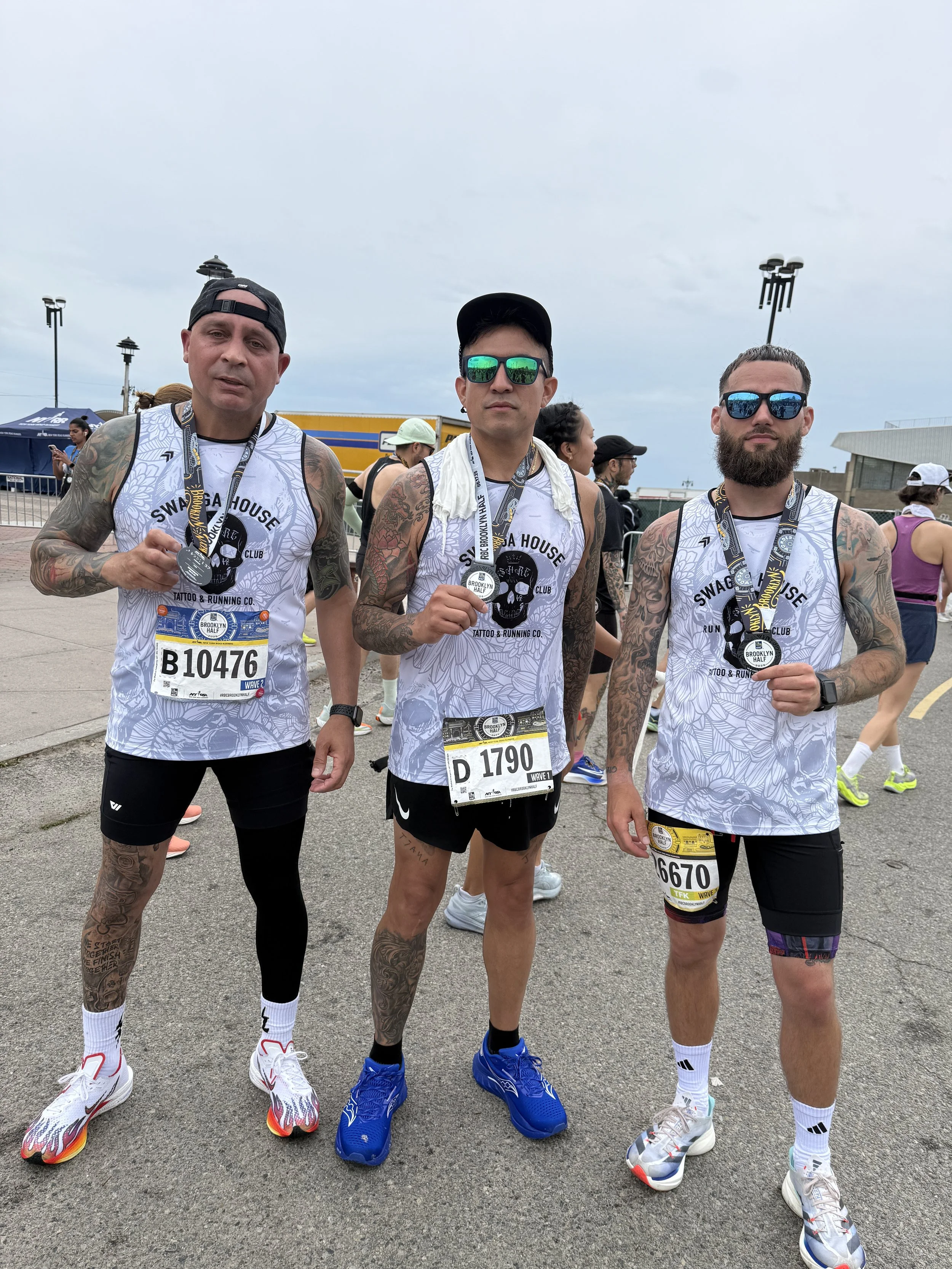
These jerseys highlight unique, custom designs specific to these guys and their brand.
